Kenya's e-commerce market is at an inflection point. The early phase of "get people to buy online at all" is ending. What comes next will look very different from the platform-dominated model that most people still associate with African e-commerce.
I've spent the past few months talking to brands, shops, and retailers across Kenya about how they sell online, what's working, what's not, and where they're investing. The picture that emerges is consistent enough to make some predictions.
Here's where I think Kenya's e-commerce space is heading over the next five years.
1. Traditional e-commerce platforms are losing ground
The era of general-purpose online marketplaces being the default way to buy things online in Kenya is fading. Some brands I've spoken to have noted declining sales on these platforms, and Google Trends data confirms a steady drop in interest since 2020.
This doesn't mean platforms disappear. It means the market splits. The top two or three formal online retailers will consolidate and dominate platform-based shopping. They'll capture the segment of consumers who want the convenience of browsing a large catalog from a trusted name. Everyone else will struggle to differentiate.
The platforms that survive will be the ones that invest heavily in customer experience, reliability, and logistics. The rest will get squeezed from two directions: D2C brands pulling away their best products, and strong retailers pulling away their most loyal customers.
2. D2C becomes the standard, not the exception
This is the biggest shift happening right now. More and more Kenyan brands are investing in their own online shops and direct distribution channels. They're realizing that owning the customer relationship, the data, and the margin is worth the effort of building their own infrastructure.
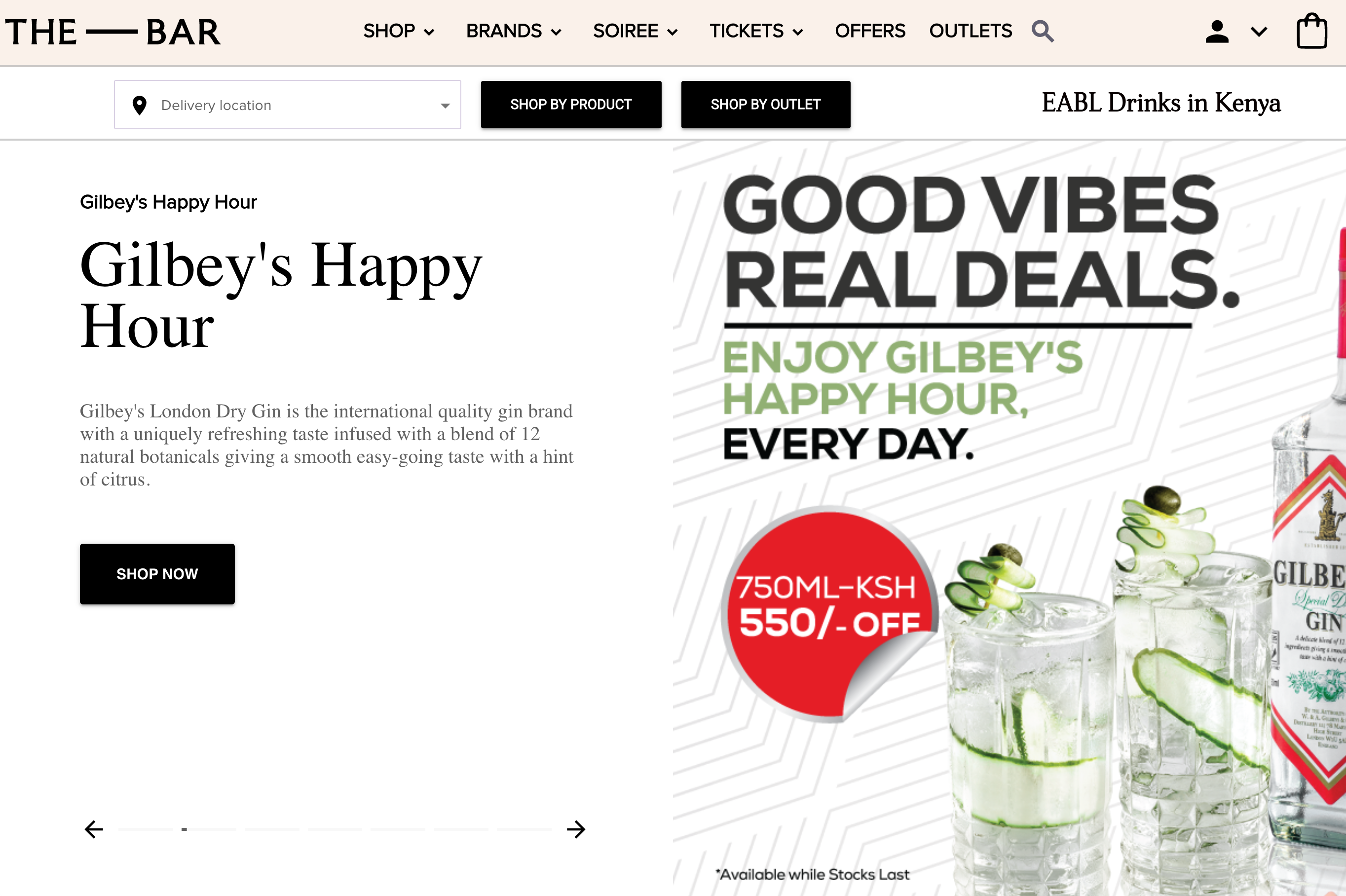 The Bar by EABL is an example of a Kenyan brand building its own D2C channel, selling premium spirits directly to consumers.
The move to D2C creates a massive opportunity for service providers. Most brands know they want to sell directly, but the operational complexity of running an online shop (inventory management, delivery logistics, payment integration, customer service) is a real barrier. Companies that help brands implement D2C operations, especially on the logistics and fulfillment side, are going to do very well over the next few years.
The brands that get this right will outperform their marketplace-dependent competitors. The brands that keep relying entirely on platforms will find themselves increasingly commoditized, competing on price alone with no direct relationship with their buyers.
3. Customer experience becomes the growth driver
For years, the conversation about e-commerce in Kenya was dominated by access and trust. Can people get online? Will they put in their payment details? Do they believe the product will actually arrive?
Those barriers are not gone, but they're shrinking. And as they shrink, the competitive frontier moves to something more familiar: customer experience. The brands and retailers that deliver a genuinely good buying experience will grow. The ones that don't will lose to those that do.
Carrefour's app has already shown what's possible. It works reliably. The product catalog is accurate. Delivery is predictable. That sounds basic, but in a market where "product shown is not the product delivered" is still a common complaint, basic reliability is a competitive advantage.
Over the next five years, UX quality, delivery reliability, accurate product information, and responsive customer service will separate the winners from everyone else. This is the phase where e-commerce in Kenya starts to feel like e-commerce everywhere else: the product with the best experience wins, regardless of who was first.
4. WhatsApp becomes a key channel, but not the checkout
WhatsApp commerce is already happening at scale in Kenya. Walk into any informal retailer, mid-size supplier, or consumer brand and you'll find that WhatsApp is already a primary sales channel — orders placed over chat, catalogues shared as images, payments confirmed via screenshot. This isn't a future trend; it's the present reality for a large portion of Kenyan commerce.
What changes over the next five years is how this gets formalized. The brands that currently run WhatsApp as an informal, human-driven channel will start using AI-powered messaging to handle product recommendations, promotions, order updates, and customer service at scale. WhatsApp will stop being a workaround and become a deliberate, structured part of the customer experience.
But I don't think WhatsApp will evolve into the primary transaction layer. Even as the engagement happens on WhatsApp, purchases will mostly complete outside it — in web-based checkouts that offer a full catalog, proper payment integration, and order tracking. WhatsApp will remain the conversation that leads to the purchase, not the place where the purchase is finalized.
This matters for anyone building in this space. The opportunity is in the engagement and conversion layer (getting users from a WhatsApp conversation to a checkout), not in trying to replicate an end-to-end commerce experience inside WhatsApp itself.
5. Product discoverability is the unsolved problem
Here's something that surprised me in my conversations: many products in Kenya are genuinely hard to find online, despite being available. A brand might have exactly what you're looking for, listed on their website, in stock, ready to ship. But you'd never know it exists because the website doesn't rank on Google, the in-shop search is broken, and there's no strategy for capturing high-intent buyers.
The companies that figure out discoverability will win disproportionately. That means investing in SEO (which is still dramatically underused by Kenyan retailers), building functional on-site search, and creating strategies to capture customers who already know what they want and are actively looking for it.
This is low-hanging fruit. The competition for organic search traffic in most Kenyan retail categories is still thin. A brand that commits to basic SEO and content strategy today will have a significant advantage within a year or two.
6. Quick commerce consolidates around one or two winners
Nairobi is already seeing real quick commerce activity. Carrefour, Greenspoon, Tushop, and Glovo are all competing for the "deliver groceries and essentials fast" market. The demand is clearly there.
But quick commerce is an expensive, logistics-heavy business that rewards scale and punishes fragmentation. Within five years, I expect this space to consolidate around one or two dominant players in Nairobi. The winners will be the ones with the best delivery infrastructure and the deepest supplier relationships. Everyone else will either get acquired or run out of money.
Outside Nairobi, quick commerce will remain limited. The economics require urban density and delivery infrastructure that most Kenyan cities don't yet have.
7. Trust stops being the main bottleneck
I'm seeing a significant shift in how Kenyan e-commerce brands approach trust. Across the board, companies are investing in trust-building content, CX-focused marketing, transparent return policies, and social proof. This isn't accidental. It's a coordinated effort across the industry, and I'm convinced it's going to pay off.
Within five years, trust will no longer be the primary reason Kenyans hesitate to buy online. It will still matter (it matters everywhere), but it won't be the first objection anymore. The first objection will shift to the same things it is in mature e-commerce markets: price, convenience, product fit, and delivery speed.
That said, buying from unknown sellers on open marketplaces and social commerce will remain harder. Consumer trust extends to brands and retailers people recognize, not to anonymous sellers on Instagram or Facebook. One area where I see potential: category-specific marketplaces in fashion or furniture that build in buyer protection, verified sellers, and safe payment flows. These could carve out meaningful niches where general marketplaces have failed.
8. E-commerce goes mainstream
The net effect of all these trends is that online shopping in Kenya will become normal. Not a novelty, not a convenience for tech-savvy early adopters, but a routine part of how people buy things.
The drivers won't be technology or logistics alone. They'll be relatable marketing that reflects how Kenyans actually live and shop. Trust-building that addresses real concerns instead of copying Western playbooks. And customer experiences that make buying online feel easier and more reliable than the alternative.
The companies that win the next five years of Kenyan e-commerce won't necessarily be the biggest or the best-funded. They'll be the ones that understand Kenyan consumers, build for how they actually behave, and earn trust through consistently good experiences.